

Key Questions to Ask a Potential Drinkware Factory About Quality Control
When selecting a drinkware manufacturing partner, quality control (QC) is a make - or - break factor. The quality of your drinkware—whether it’s tumblers, mugs, water bottles, or glassware—impacts product safety, customer satisfaction, and your brand’s reputation. To ensure you partner with a factory that prioritizes excellence, here are the critical questions to ask about their quality control processes, informed by industry best practices (and insights from GreatDrinkware’s commitment to quality).
1. What Are Your Raw Material Inspection Procedures?
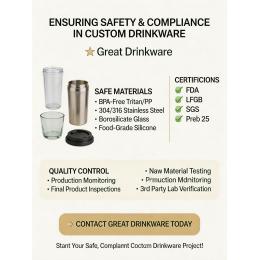
Raw materials (e.g., stainless steel, food - grade plastics, borosilicate glass) form the foundation of your drinkware. Ask about: Supplier vetting: Do you source materials from certified or audited suppliers? Inspection protocols: How do you test materials for safety (e.g., food contact compliance, heavy metal content) and quality (e.g., material strength, purity)? Documentation: Can you provide certificates of analysis (COAs) or test reports for incoming materials? A rigorous raw material inspection prevents issues like contamination, structural weaknesses, or non - compliance with food safety standards (e.g., FDA 21 CFR for plastics, EU’s REACH for chemicals).
2. How Is Quality Monitored During the Production Process?
QC during production catches issues before they escalate. Inquire about: Process controls: Do you follow Standard Operating Procedures (SOPs) for each production stage (e.g., molding, welding, polishing)? Inspection frequency: How often are in - process checks performed (e.g., hourly, per batch)? Who conducts them (trained QC staff or operators)? Deviation management: How do you address production errors (e.g., rework, scrap, process adjustments) to prevent defective products? For example, a factory might use statistical process control (SPC) to identify trends in defects and adjust machinery parameters.
3. What Final Product Testing Protocols Do You Follow?
Final testing ensures products meet specifications. Key areas to probe: Functional testing: Leakage tests (for lids, seals), thermal shock resistance (for insulated drinkware), load testing (for durability). Aesthetic and dimensional checks: Visual inspection for scratches, color consistency; measurement of dimensions (e.g., cup volume, lid fit) against design specs. Sampling methods: Do you use Acceptable Quality Limits (AQL) sampling (e.g., AQL 1.5 for critical defects)? How do you handle failed batches? For food - contact drinkware, additional tests like migration testing (for plastics) or corrosion testing (for metals) may be critical.
4. Do You Hold Any Quality or Safety Certifications?
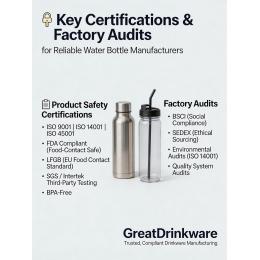
Certifications validate compliance with global standards: ISO certifications: ISO 9001 (quality management) or ISO 14001 (environmental management) demonstrate structured processes. Food safety certifications: FDA (US), LFGB (EU), or GB 4806 (China) for food - contact materials. Industry - specific certifications: For example, BPA - free, dishwasher - safe claims should be backed by testing. Ask to see certification documents and confirm they’re up - to - date (not expired or suspended).
5. How Do You Address Post - Sale Quality Issues?
Quality control doesn’t end at production. Ask: Complaint handling: How do you track and resolve customer - reported issues (e.g., leaks, broken parts)? Root cause analysis (RCA): Do you conduct RCA for recurring issues (e.g., using 5 Whys, FMEA)? Continuous improvement: How are lessons from complaints integrated into your QC processes (e.g., updating SOPs, retraining staff)? A factory that proactively uses post - sale feedback to refine processes is more likely to deliver consistent quality over time.
6. Can You Share Examples of QC Process Improvements?
Look for a partner with a track record of evolving their QC: Did you implement new testing equipment (e.g., automated leak detectors) to reduce human error? Have you updated procedures to meet stricter global standards (e.g., new EU food safety regulations)? Can you share case studies of how QC changes improved product quality (e.g., reducing defect rates by X%)? This shows a commitment to excellence, not just compliance.
Conclusion: Asking these questions (and verifying answers with audits, documents, or site visits) helps you assess a drinkware factory’s QC maturity. A partner with robust, evolving processes ensures your products are safe, durable, and aligned with your brand’s quality standards—protecting your reputation and customer trust. For more insights on drinkware manufacturing excellence, explore GreatDrinkware’s resources or contact their team to discuss your project’s QC needs.

 English
 German
 French
 Russian
 Spanish
 Japanese
 Korean
 Portuguese
 Ukrainian
 Arabic
 Italian


