

Custom Mold Development for Unique Bottle Designs: Process & Cost Implications
In the competitive drinkware and beverage packaging industry, standing out with a unique bottle design can be a game-changer. However, bringing a custom bottle concept to life requires investing in a private (custom) mold—a specialized tool that shapes your exclusive design. Let’s dive into the process and cost factors involved in developing a custom mold for your unique bottle, leveraging insights from GreatDrinkware’s expertise in drinkware manufacturing.
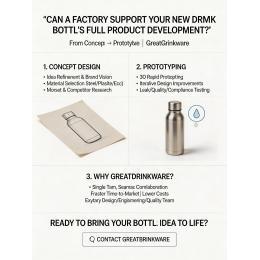
Step 1: Design Finalization & Technical Specifications
Before mold development begins, your bottle’s design must be fully finalized. This stage involves:
- Creating detailed 2D/3D renderings (often via CAD software) of the bottle, including dimensions, wall thickness, neck finish, and any unique features (e.g., embossed logos, textured surfaces).
- Confirming material compatibility (e.g., PET, glass, plastic resin) and production requirements (e.g., injection molding vs. blow molding for plastic bottles).
- Collaborating with engineers to ensure the design is mold-friendly (e.g., draft angles for easy ejection, structural integrity for high-volume production).
Step 2: Mold Fabrication Process
Once the design is locked in, the mold manufacturing process unfolds in several key phases:
- Mold Design & Tooling Planning: Engineers translate your 3D model into a mold design, specifying cavity count (single or multi-cavity molds), cooling channels, and ejection mechanisms. Multi-cavity molds increase production speed but raise initial costs.
- Mold Material Selection: Common materials include:
- Aluminum: Lower cost, faster production, ideal for short-run or prototype molds (less durable for high-volume use).
- Steel (e.g., P20, H13): Higher cost, superior durability, and heat resistance—critical for millions of cycles in large-scale production.
- Machining & EDM (Electrical Discharge Machining): Precision CNC machining or EDM shapes the mold cores and cavities. Complex designs (e.g., intricate textures, undercuts) require more time and specialized techniques, driving up costs.
- Polishing & Finishing: The mold’s surface is polished (or textured) to match the desired bottle finish (e.g., glossy, matte, or custom patterns). This step ensures the bottle’s aesthetic quality.
- Assembly & Testing (Trial Run): The mold is assembled, then tested with a small batch of “trial” bottles. Adjustments are made for defects (e.g., warping, uneven walls) before full production.
Cost Factors for Custom Mold Development
The total cost of a custom mold varies widely (from $5,000 to $100,000+ for plastic bottle molds, depending on complexity). Key drivers include:
- Design Complexity: Intricate shapes, undercuts, or custom textures require more engineering time and machining, increasing costs. A simple cylindrical bottle mold will cost far less than one with embossed artwork or irregular geometry.
- Mold Material & Durability: Steel molds cost 2–3x more than aluminum but last 10x longer (e.g., an aluminum mold might handle 100,000 cycles, while steel handles 1,000,000+).
- Cavity Count: A single-cavity mold is cheaper upfront but produces only one bottle per cycle. Multi-cavity molds (e.g., 8 or 16 cavities) reduce per-unit costs long-term but raise initial investment.
- Production Volume & Long-Term Savings: While mold costs are high, unit costs drop significantly with higher production runs. For example, a $50,000 steel mold might seem expensive, but if it produces 1,000,000 bottles at $0.10 per unit (vs. $0.50 with a cheaper mold), the ROI becomes clear.
- Post-Mold Costs: Maintenance (e.g., repairs, re-polishing) and potential modifications (e.g., updating a logo) add to long-term costs. Factor in a 5–10% annual maintenance budget for high-use molds.
Why Invest in a Private Mold? Long-Term Benefits
While custom molds require a significant upfront investment, they offer strategic advantages:
- Brand Exclusivity: A unique bottle design differentiates your product on shelves, reducing competition from generic packaging.
- Cost Efficiency at Scale: As production volume grows, the mold’s cost is amortized, lowering per-unit costs over time.
- Quality Control: Owning the mold gives you full control over design consistency, material quality, and production timelines.
Tips for Minimizing Mold Costs
To optimize your investment, consider these strategies:
- Start with a prototype mold (e.g., aluminum) to test the design before committing to a high-cost steel mold.
- Simplify the design where possible (e.g., avoid unnecessary undercuts) to reduce machining time.
- Partner with an experienced manufacturer (like GreatDrinkware) to leverage their expertise in mold optimization and cost-efficient production.
In conclusion, developing a custom mold for a unique bottle design is a multi-step process that balances upfront costs with long-term brand and financial benefits. By understanding the process, cost drivers, and ROI potential, businesses can make strategic decisions to bring their innovative drinkware concepts to market successfully.

 English
 German
 French
 Russian
 Spanish
 Japanese
 Korean
 Portuguese
 Ukrainian
 Arabic
 Italian


