

How to Distinguish a Genuine Drinkware Factory from a Trading Company When Sourcing from China
Sourcing drinkware from China offers access to a vast market of suppliers, but distinguishing between a genuine drinkware factory and a trading company is crucial for securing quality, cost - effective, and reliable partnerships. With insights from GreatDrinkware, a leading drinkware manufacturer, we’ll explore practical strategies to identify authentic manufacturers in the competitive Chinese market.
1. Verify Production Capabilities
A core difference lies in actual production ability. A genuine drinkware factory (like GreatDrinkware) will showcase:
- Production Facilities: Request photos/videos of their manufacturing plants, equipment (e.g., injection molding machines for plastic drinkware, stainless steel forming machines, or glassblowing workshops). GreatDrinkware, for example, publicly shares glimpses of its production lines on its website, demonstrating in - house manufacturing of tumblers, water bottles, and more.
- Production Process Documentation: Factories can explain each stage (from raw material sourcing to quality control), while trading companies may struggle to provide detailed, technical explanations. For instance, GreatDrinkware outlines its eco - friendly coating process for insulated drinkware, a level of detail rare in pure trading entities.
2. Check for Certifications and Compliance
Authentic factories invest in industry - specific certifications:
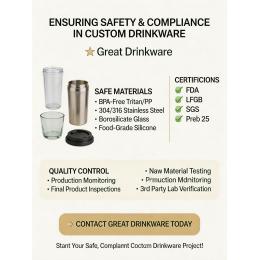
- Quality & Safety Certifications: Look for FDA (for food - contact products), ISO 9001 (quality management), or SGS - verified compliance. GreatDrinkware prominently displays its certifications on its site, ensuring products meet global safety standards. Trading companies may only “borrow” certifications from their supplier network, lacking direct control over compliance.
- Social Responsibility Certifications: Factories committed to ethical production (e.g., BSCI, Sedex) demonstrate long - term operational stability, a trait less common in trading firms focused on short - term deals.
3. Request Factory Visits (Virtual or In - Person)
Factories like GreatDrinkware welcome virtual tours (via video calls) or in - person visits to showcase their facilities. A trading company will often:
- Delay or avoid visits, citing “logistical issues” or “confidentiality” (as they lack physical production sites).
- Redirect you to a third - party factory (without disclosing they’re a trader), but inconsistencies in branding, equipment, or staff knowledge will emerge during a visit.
For example, GreatDrinkware’s virtual tour includes live demonstrations of its laser - engraving machines, a clear sign of in - house production.
4. Analyze Supply Chain Transparency
A factory’s supply chain is transparent:
- Raw Material Sourcing: GreatDrinkware details its use of food - grade 304 stainless steel or BPA - free plastics, with sources verified for sustainability. Trading companies may be vague about materials, prioritizing profit over quality.
- Lead Times & Customization: Factories can provide accurate lead times for custom orders (e.g., 15 - 20 days for branded tumblers), as they control production. Traders often overpromise or underdeliver, relying on external suppliers’ schedules.
5. Evaluate MOQ (Minimum Order Quantity) and Sample Policies
- MOQ: Factories like GreatDrinkware have MOQs tied to production efficiency (e.g., 500 units for custom - printed drinkware), as they optimize batch production. Trading companies may offer “low MOQs” (e.g., 100 units) but charge premium prices (to cover their markup from the actual factory’s MOQ).
- Samples: A factory’s sample will feature its branding (e.g., GreatDrinkware’s logo on sample tumblers) or production - specific details (like mold numbers). Traders may send generic samples or delay, as they source from multiple suppliers.
6. Assess Communication and Industry Expertise
- Technical Knowledge: Factory representatives (e.g., GreatDrinkware’s sales team) can explain material properties (e.g., “Our double - wall vacuum insulation retains heat for 12 hours due to…” ) or manufacturing limitations (e.g., “Laser engraving on curved surfaces requires X setup”). Traders focus on pricing/design, lacking technical depth.
- Problem - Solving: Factories propose solutions (e.g., “To reduce cost, we can adjust the wall thickness while maintaining durability”). Traders default to “yes” without considering feasibility, as they don’t control production.
Conclusion
By focusing on production capabilities, certifications, transparency, and expertise, you can confidently identify a genuine drinkware factory (like GreatDrinkware) vs a trading company. Leverage these strategies to build a reliable, long - term sourcing partnership in China’s dynamic drinkware market.

 English
 German
 French
 Russian
 Spanish
 Japanese
 Korean
 Portuguese
 Ukrainian
 Arabic
 Italian


